Schema Therapy: A Practitioner's Guide by Young Jeffrey E. & Klosko Janet S. & Weishaar Marjorie E
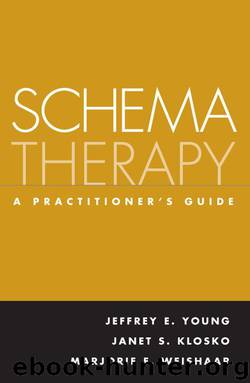
Author:Young, Jeffrey E. & Klosko, Janet S. & Weishaar, Marjorie E. [Young, Jeffrey E.]
Language: eng
Format: mobi
ISBN: 9781606238349
Publisher: Guilford Publications
Published: 2006-11-02T16:00:00+00:00
Defectiveness/Shame
Typical Presentation of the Schema
Patients with this schema believe that they are defective, flawed, inferior, bad, worthless, or unlovable. Consequently, they often experience chronic feelings of shame about who they are.
What aspects of themselves do they view as defective? It could be almost any personal characteristic—they believe that they are too angry, too needy, too evil, too ugly, too lazy, too dumb, too boring, too strange, too overbearing, too fat, too thin, too tall, too short, or too weak. They might have unacceptable sexual or aggressive desires. Something in their very being feels defective: It is not something they do, but something they feel they are. They fear relationships with others because they dread the inevitable moment when their defectiveness will be exposed. At any moment, other people might suddenly see through them to the defectiveness at their core, and they will be filled with shame. This fear can apply to the private or public worlds: Patients with this schema feel defective in their intimate relationships or in the wider social world (or both).
Typical behaviors of patients with this schema include devaluing themselves and allowing others to devalue them. These patients may allow others to mistreat or even verbally abuse them. They are often hypersensitive to criticism or rejection, and react very strongly, either by becoming sad and downcast or angry, depending upon whether they are surrendering to the schema or overcompensating for it. They secretly feel that they are to blame for their problems with other people. Often self-conscious, they tend to make a lot of comparisons between themselves and others. They feel insecure around other people, particularly those perceived as “not defective,” or those who might see through to their defectiveness. They may be jealous and competitive, especially in the area of their felt defectiveness, and sometimes view interpersonal interactions as a dance of “one up, one down.” They often choose critical and rejecting partners, and may be critical of the people who love them. (Groucho Marx expressed the latter sentiment when he said, “I wouldn’t want to belong to a club that would have me as a member.”) Many of the characteristics of narcissistic patients—such as grandiosity and unrelenting standards—can be manifestations of a Defectiveness schema. In many cases, these characteristics serve to compensate for underlying feelings of defectiveness and shame.
Patients may avoid intimate relationships or social situations, because people might see their defects. In fact, we believe that avoidant personality disorder is a common manifestation of the Defectiveness schema, with avoidance as the primary coping style. This schema can also lead to substance abuse, eating disorders, and other serious problems.
Download
This site does not store any files on its server. We only index and link to content provided by other sites. Please contact the content providers to delete copyright contents if any and email us, we'll remove relevant links or contents immediately.
Unwinding Anxiety by Judson Brewer(73424)
The Art of Coaching by Elena Aguilar(53657)
The Fast Metabolism Diet Cookbook by Haylie Pomroy(21261)
Rewire Your Anxious Brain by Catherine M. Pittman(18798)
Healthy Aging For Dummies by Brent Agin & Sharon Perkins RN(17124)
Talking to Strangers by Malcolm Gladwell(13542)
The Art of Thinking Clearly by Rolf Dobelli(10719)
Mindhunter: Inside the FBI's Elite Serial Crime Unit by John E. Douglas & Mark Olshaker(9525)
Crazy Rich Asians by Kevin Kwan(9419)
The Compound Effect by Darren Hardy(9153)
Tools of Titans by Timothy Ferriss(8594)
Periodization Training for Sports by Tudor Bompa(8417)
Becoming Supernatural by Dr. Joe Dispenza(8375)
Wonder by R. J. Palacio(8242)
Bodyweight Strength Training by Jay Cardiello(8029)
Crystal Healing for Women by Mariah K. Lyons(8009)
Change Your Questions, Change Your Life by Marilee Adams(7936)
Nudge - Improving Decisions about Health, Wealth, and Happiness by Thaler Sunstein(7854)
Should I Stay or Should I Go? by Ramani Durvasula(7782)
